
History of Hoysala: The Dynasty That Carved Karnataka's Golden Age in Stone
The history of Hoysala is one of the most fascinating chapters in the cultural story of Karnataka. Between the 11th and 14th centuries, the Hoysala dynasty grew from a regional power in the Malnad hills into one of South India's most influential kingdoms. Their rulers built cities, protected trade routes, encouraged literature, supported different faith traditions and commissioned temples so detailed that even today visitors slow down instinctively before every wall, pillar and sculpture.
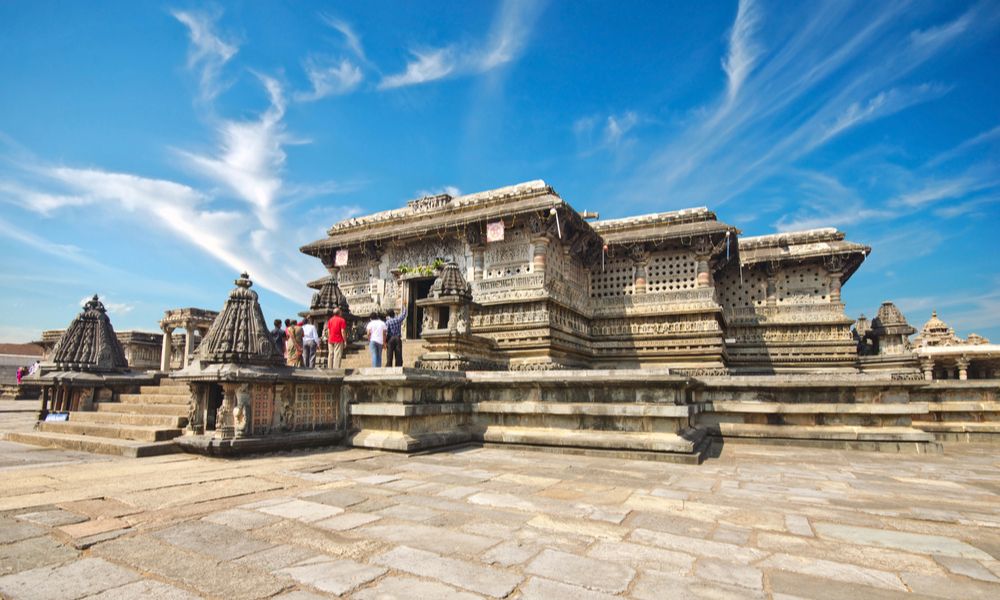
For travellers coming to Belur, Halebidu or Somanathapura, Hoysala history is not a distant classroom topic. It is visible in star-shaped temple platforms, polished soapstone pillars, sculpted dancers, mythological friezes, royal emblems and inscriptions that still speak across centuries. Belur's Chennakeshava Temple, Halebidu's Hoysaleswara Temple and Somanathapura's Keshava Temple are now globally recognized as the Sacred Ensembles of the Hoysalas, a UNESCO World Heritage property. That recognition confirms what local people have known for generations: the Hoysala legacy is one of India's great artistic inheritances.
Who Were the Hoysalas?
The Hoysalas were a South Indian dynasty whose power was centered in present-day Karnataka. Their earliest roots are associated with the hilly Malnad region, especially around places such as Angadi and the Western Ghats belt. From these uplands, they expanded into the fertile plains and politically important temple towns of southern Karnataka.
The name Hoysala is linked to a popular legend. According to tradition, a young hero named Sala was instructed by his teacher to strike a tiger. The phrase "Hoy, Sala!" is often interpreted as "Strike, Sala!" This story became connected with the royal emblem, where a warrior is shown attacking a tiger or fierce animal. Whether read as history, legend or political symbolism, the story communicates something essential about the dynasty: courage, guardianship and the transformation of a local warrior lineage into a royal house.
Historically, the Hoysalas first served as feudatories under larger powers, including the Western Chalukyas. Over time, they took advantage of shifting political conditions in the Deccan and Tamil regions to establish their own authority. Their story is therefore not simply about temples; it is about ambition, regional identity, military skill and the rise of Karnataka as a powerful cultural zone.
The Rise of the Hoysala Kingdom
The early Hoysala rulers began consolidating power around the 10th and 11th centuries. Their initial territory was smaller, but the location was strategic. The Malnad hills connected the coast, forest resources, inland trade routes and agricultural settlements. This gave the Hoysalas access to both natural wealth and movement corridors.
One of the most important figures in the dynasty's rise was King Vishnuvardhana, who ruled in the 12th century. His reign marked a turning point. The Hoysalas expanded militarily, gained prestige and became major patrons of religion and architecture. Belur rose in importance during this period, and the Chennakeshava Temple became one of the dynasty's defining monuments.
Vishnuvardhana's period also shows the complex religious world of medieval Karnataka. Royal patronage moved across Jain, Shaiva and Vaishnava traditions. Queens, generals, merchants and local elites also funded temples and religious institutions. Hoysala history is therefore best understood as a layered cultural landscape where many communities contributed to the kingdom's public life.
The Hoysalas did not leave behind only monuments; they left a way of seeing stone as story, devotion, politics and craftsmanship at once.
Belur: The First Great Hoysala Capital
Belur, located in Hassan district of Karnataka, is deeply tied to the story of Hoysala power. Known historically as Velapura, it became an important royal and religious center. The Chennakeshava Temple at Belur, dedicated to Lord Vishnu, is one of the finest examples of Hoysala architecture and a major reason heritage travellers visit the town today.
The temple was commissioned during the reign of Vishnuvardhana in the 12th century. It is often associated with the king's victory over the Cholas, though its meaning is broader than a single event. The temple expresses royal devotion, artistic confidence and the political statement of a dynasty announcing itself as a major power in South India.
What makes Belur unforgettable is the density of detail. Sculptures of dancers, musicians, elephants, horses, warriors, deities and scenes from epics wrap around the temple like a carved manuscript. The famous bracket figures, often called madanikas or shilabalikas, display grace, ornament and movement with astonishing refinement. Even a quick visit makes one thing clear: Hoysala artists were not merely decorating stone; they were turning it into living narrative.
Halebidu: Dorasamudra and the Imperial Moment
As Hoysala power expanded, the capital shifted to Dorasamudra, the city now known as Halebidu. The name Halebidu means "old capital" or "ruined city," a reminder of both grandeur and loss. During the height of the empire, Dorasamudra was a major political and cultural center. It reflected the Hoysalas at their most ambitious.
The Hoysaleswara Temple at Halebidu, dedicated to Lord Shiva, is among the greatest monuments of medieval India. It is known for its twin-shrine plan, sculptural bands and extraordinary surface treatment. Elephants, lions, scrollwork, gods, goddesses, dancers and epic scenes move across the walls in carefully organized layers. The temple was never fully completed in the way its builders may have intended, yet that unfinished quality has not reduced its greatness. In fact, it allows modern visitors to sense the scale of the project and the human labor behind it.
Halebidu also carries the memory of invasion and political disruption. In the early 14th century, armies from the Delhi Sultanate attacked the Hoysala capital. These attacks weakened the kingdom and damaged its centers of power. Still, the Hoysala legacy did not vanish. Their artistic language, administrative habits and regional influence continued to shape later Karnataka history.
Major Hoysala Rulers
The Hoysala dynasty had several important rulers, each contributing to its military strength, temple patronage and cultural influence. A simplified timeline helps place the story in context:
- Nrupa Kama II: An early ruler associated with the growth of Hoysala authority in the Malnad region.
- Vinayaditya: A ruler who helped strengthen Hoysala status while the dynasty was still connected to larger Deccan powers.
- Vishnuvardhana: One of the most celebrated Hoysala kings, remembered for expansion, prestige and the commissioning of major monuments such as the Chennakeshava Temple at Belur.
- Narasimha I: Continued the consolidation of the kingdom after Vishnuvardhana's reign.
- Veera Ballala II: A powerful monarch under whom the Hoysalas reached one of their greatest phases of influence across southern India.
- Vira Someshwara: Ruled during a period when Hoysala politics became deeply involved with Tamil country and Deccan power struggles.
- Veera Ballala III: One of the last major Hoysala rulers, remembered for resisting northern invasions and for the dynasty's final phase before its decline.
Hoysala Architecture: Why It Still Feels Alive
Hoysala architecture is one of the main reasons the dynasty remains famous. Their temples are usually built with chloritic schist, commonly called soapstone. This material is relatively soft when quarried, allowing sculptors to create fine detail, and it hardens over time. The result is a surface that can hold jewelry-like carving, crisp lines and delicate ornament.
Several features make Hoysala temples distinctive. Many stand on raised star-shaped platforms, allowing devotees and visitors to walk around the shrine while viewing sculptural panels. The walls often have rhythmic projections and recesses, giving the temple a dynamic outline rather than a simple box-like form. Pillars inside the halls are frequently lathe-turned and polished, producing a smooth, almost metallic finish.
Hoysala sculpture is especially rich in storytelling. The lower friezes often include elephants for strength, horses for speed, foliage for abundance, scenes from the Ramayana and Mahabharata, and images of deities from Hindu traditions. This creates a temple experience that is both devotional and educational. A visitor can read the walls visually, moving from earthly power to divine narrative.
Religion, Language and Culture Under the Hoysalas
The Hoysala period was culturally diverse. Jainism had a strong presence in Karnataka before and during early Hoysala rule. Shaivism and Vaishnavism also received royal support. Instead of imagining the dynasty through a single religious identity, it is more accurate to see Hoysala society as a space where multiple traditions existed, competed and flourished.
Kannada literature received important patronage during this era. Court poets, scholars and religious writers contributed to the growth of Kannada as a literary language. Sanskrit also remained influential in inscriptions, religious learning and elite culture. The Hoysala age therefore strengthened Karnataka's intellectual and artistic identity in more than one language.
Artisans were central to this world. The names of sculptors and architects appear in inscriptions, reminding us that Hoysala monuments were not anonymous miracles. They were made by trained guilds, master craftsmen, metalworkers, planners, patrons and laborers. Each temple was a collaboration between power, faith and skill.
Trade, Administration and Everyday Life
Behind the beauty of Hoysala temples was a functioning kingdom. The dynasty managed agrarian resources, temple grants, local chiefs, merchant groups and military campaigns. Temples were not only places of worship. They also served as employers, landholders, cultural venues and centers of redistribution. Musicians, dancers, priests, oil suppliers, flower providers, cooks, guards and artisans could all be connected to temple economies.
The location of Hoysala power helped link the Malnad hills, the Deccan plateau and the Tamil regions. Agricultural expansion, irrigation tanks, market settlements and road networks were part of the kingdom's material base. The wealth that produced stone temples came from land, trade, taxation, tribute and the careful organization of local society.
The Decline of the Hoysala Empire
By the late 13th and early 14th centuries, the political landscape of South India had become unstable. The Pandyas, Cholas, Seunas, Kakatiyas and later the Delhi Sultanate all shaped the pressures around Hoysala territory. Repeated invasions from the north weakened Dorasamudra, while regional conflicts stretched the dynasty's military capacity.
Veera Ballala III tried to maintain Hoysala authority during this turbulent period. However, after his death in the 14th century, the dynasty's independent power faded. The rise of the Vijayanagara Empire soon transformed the politics of South India. Many historians see the Hoysalas as one of the important regional powers whose legacy helped prepare the cultural ground from which Vijayanagara emerged.
The decline of political power did not mean the decline of cultural memory. Belur and Halebidu continued to live as sacred, artistic and local heritage sites. The temples remained part of Karnataka's identity long after the royal court disappeared.
Why Hoysala History Matters Today
Hoysala history matters because it brings together art, regional pride, engineering, religion and public memory. For Karnataka, the dynasty represents a period when local power produced world-class architecture. For India, it shows how regional kingdoms shaped the subcontinent's cultural richness. For travellers, it offers a direct encounter with medieval imagination.
The UNESCO recognition of the Sacred Ensembles of the Hoysalas has brought renewed attention to Belur, Halebidu and Somanathapura. But the true importance of these places is felt on the ground: in the quiet of temple courtyards, in the patience of sculpted stone, in the stories guides tell, and in the way local communities continue to live around these monuments.
Planning a Hoysala Heritage Visit
If you are visiting Belur, start with the Chennakeshava Temple and give yourself enough time to walk slowly around the outer walls. Halebidu is close enough to combine in the same heritage circuit, while Somanathapura can be included in a longer Karnataka itinerary. Early mornings and late afternoons are ideal for photography, softer light and a calmer experience.
A heritage trip also becomes more meaningful when paired with local food. Around Belur and the Malnad region, traditional meals connect visitors to the landscape that sustained these kingdoms: rice, ragi, coconut, spices, country chicken preparations, mutton saaru and comforting local dishes that carry the flavor of the hills.
Conclusion
The history of Hoysala is the story of a dynasty that rose from the Malnad region and shaped the cultural map of Karnataka. Their kings built capitals at Belur and Halebidu, their artists transformed soapstone into poetry, and their temples continue to draw travellers, historians, architects and devotees from across the world.
To understand the Hoysalas is to understand that history is not only written in books. Sometimes it is carved into pillars, folded into temple walls, remembered in town names and kept alive by every visitor who pauses before the stone and looks carefully.